
Industries · Burger & QSR
Burger Shop & QSR Equipment
Commercial burger shop equipment for the whole fit-out — griddles and chargrills, deep fryers, bun toasters, holding cabinets and refrigerated prep, curated for Australian burger bars and quick service restaurants. In a QSR kitchen, speed of service sets the ceiling on revenue: every station has to clear its share of the order in the same short window, so it pays to spec the cookline, the cold line and the front counter together instead of piece by piece. This range pulls the fast food equipment a burger kitchen actually runs on into one place. It sits alongside our other industry equipment ranges; for the full ranges behind it, browse commercial cooking equipment and commercial refrigeration.
Shop Burger Shop & QSR Equipment by Category

Chargrills
Shop the chargrills range →
Griddles
Shop the griddles range →
Fryers
Shop the fryers range →
Bun toasters
Shop the bun toasters range →
Holding cabinets
Shop the holding cabinets range →
Prep fridges
Shop the prep fridges range →Who this burger shop equipment range is for
Fitting out a burger kitchen is a throughput problem before it's a shopping list. A new site needs a griddle or grill for the patties, fryers that keep chips moving, a toaster for the buns, a cold bench where every burger is built and hot holding so nothing dies at the pass — and each of those choices sets how fast orders leave the window. This range is built for owners starting a burger restaurant or takeaway, QSR operators refurbishing or opening a second store, chicken shops and kebab bars adding burgers to the menu, and food trucks working a compact footprint. If the menu leans to battered fish, the fish and chips equipment range covers that trade, and full-service venues should start with restaurant equipment; start here when burgers are the business.

Benchstar
Benchstar Two Slice Conveyor Toaster Electric TT-300E368(W) x 420(D) x 390(H)mm
$782.00 +GST$920.00

GasMax
GasMAX Superfast LPG Gas Tube Fryer RC300ELPG394(W) x759(D) x1195(H) mm
$1,563.00 +GST$2,299.00
GasMax
GasMAX Superfast 18L Natural Gas Tube Fryer RC300E394(W) x759(D) x1195(H) mm
$1,563.00 +GST$2,299.00

FryMAX
FryMAX 22L Oil Superfast LPG Gas Tube Fryer RC400ELPG394(W) x 759(D) x 1195(H)mm
$1,870.00 +GST$2,750.00
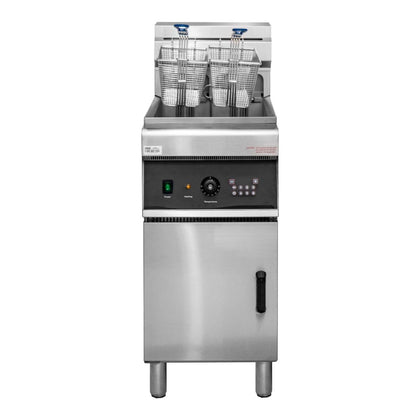

FED-X
FED-X 1500mm Salad Bench Countertop Prep Fridge XVRX1500/380S1500(W) x 395(D) x 281(H)mm
$967.50 +GST$1,290.00

FED-X
FED-X 1200mm Countertop Prep Fridge Salad Bench Stainless Lid XVRX1200/380S1200(W) x 395(D) x 281(H) mm
$892.50 +GST$1,190.00

F.H.E
F.H.E 20-Pan Food Warmer Cart Holding Cabinet HT-20S515(W) x 780(D) x 1763(H)mm
$2,805.00 +GST$3,300.00
What a burger kitchen fit-out covers
Zone by zone — every line links to the matching range so you can build your kit as you read.
Griddles and chargrills
The patty line is the heart of the kitchen. A flat commercial griddle gives smash burgers their crust, holds a steady heat across the plate and handles onions, bacon and eggs on the same surface; a chargrill puts real char and grill marks on flame-cooked patties and chicken. Plenty of burger kitchens run both and split the menu across them. Whichever way you cook, buy plate area for your busiest hour — a crowded cook surface is the most common bottleneck in a burger kitchen, and no roster can out-work an undersized griddle.
Deep fryers and chip warmers
Chips ride on almost every order, so the fryer bank earns its gas line. A twin-tank commercial deep fryer keeps chips and proteins in separate oil — essential once fried chicken joins the menu — while compact sites can run a benchtop deep fryer where floor space is tight. A chip warmer holds cooked fries hot and crisp through the rush instead of forcing the fryer to chase every order. Plan oil maintenance from day one: filtration and a regular oil-change routine protect flavour and running costs.
Bun toasters and hot holding
A toasted bun is the difference between a burger that holds together and one that goes soggy in the wrap. A conveyor commercial toaster caramelises the cut face of the buns at a set rate per hour, which makes output predictable at peak. Behind the cookline, holding cabinets keep cooked patties and fried chicken at safe serving temperature without drying them out — the food safety backbone of any menu that batch-cooks ahead of the rush.
Refrigerated prep and cold storage
Every burger is built on the cold bench. A countertop prep fridge works like a refrigerated prep table for the build station, keeping sauces, cheese and sliced vegetables — lettuce, tomato, onion — at temperature and within arm's reach. Under-bench fridges hold the day's patties and meat beside the griddle, and back-of-house reach-in refrigeration plus freezer capacity stores bulk frozen chips and stock between deliveries. Size the cold chain to your delivery cycle, not the quiet week, and keep raw meat storage separate from the ready-to-eat line.
Drinks and the front counter
Drinks and shakes carry margin on nearly every order. An upright display fridge at the register sells cold drinks without adding a second to service, a milkshake maker or post-mix dispenser rounds out the classic burger-bar offer, and a wash-up sink and stainless benches complete the setup. Front-counter refrigeration is self-service revenue — position it where the queue waits, not behind the counter.
How to plan a burger shop fit-out in three steps
1
Lock the menu, then map it to stations
Burgers, chips, fried chicken, shakes, drinks: every item on the menu has to earn a station with power, bench space and a clear workflow. Group the menu into cook, fry, toast, build and hold, and cut anything that can't justify its own spot — a short menu that moves fast beats a long one that queues.
2
Size the cookline to the peak hour
Count the orders you expect in your busiest hour — Friday night, not Tuesday afternoon — and size backwards from there: griddle plate area per patty, fryer capacity in baskets of chips per hour, toaster throughput in buns, and enough holding to bridge batch cooking and sales. Under-speccing the peak is the most expensive mistake in a QSR setup, because it caps revenue every single service.
3
Confirm power, gas, ventilation and bench space
Griddles, chargrills and fryers run on natural gas, LPG or three-phase power depending on the model, and open flame plus hot oil means mechanical exhaust in nearly every install. Measure the site, check each product page for the model's exact electrical, gas, clearance and extraction requirements before you order, and price any trade work into the fit-out budget.
Burger Shop & QSR Equipment FAQs
What equipment do I need to open a burger shop?+
The core burger restaurant equipment list: a griddle or chargrill for the patties, a deep fryer (twin tank if chips and chicken share the oil budget), a bun toaster, a countertop prep fridge for the build bench, under-bench and reach-in refrigeration plus a freezer for bulk frozen stock, a holding cabinet if you batch-cook, a drinks fridge at the register, stainless steel benches, a wash-up sink and an exhaust canopy over the hot line. Map your menu to stations first and let that set the final list.
Should I cook burgers on a griddle or a chargrill?+
A flat griddle suits smash-style patties — full contact with the plate builds the crust, and the same surface handles onions, eggs and bacon. A chargrill suits thicker flame-cooked patties where char flavour and grill marks sell the burger. There's no wrong answer: match the cook surface to the style on the menu, and if the menu carries both styles, run both side by side.
What equipment does adding fried chicken need?+
Fried chicken is mostly a fryer-capacity question. Give chicken its own oil — a dedicated tank or a second fryer — so the chips stay clean, add bench space for breading, and use holding that keeps the crust crisp rather than steaming it. High-volume chicken menus often step up to larger open fryers or pressure fryers; check the recovery rate on the product page against your expected orders per hour.
How much does burger shop equipment cost?+
It depends on the menu, the site and how much of the kitchen is new — the grill line, fryers and refrigeration are usually the biggest lines in the budget. The practical approach is to price your station list rather than a generic package: spec each station from this range, then decide where premium equipment pays for itself in speed and where a workhorse model does the same job for less.
Is second-hand fast food equipment worth buying?+
Second-hand can look cheap upfront, but it usually arrives without warranty, with unknown service history, and with the elements, thermostats and compressors closest to end of life — and a dead griddle or fryer stops the whole menu. Everything in this range is new commercial equipment with manufacturer warranty; see our warranty and service information for cover details.
What power and ventilation does a burger kitchen need?+
Most cooklines mix fuel types: griddles, chargrills and larger fryers commonly run on natural gas or LPG, toasters and prep fridges on standard power, and some electric units need higher-amperage circuits. Open flame and hot oil almost always require a mechanical exhaust canopy. Check each product page for the model's exact requirements and have your gasfitter and electrician confirm the site before ordering.
Do you deliver fast food equipment Australia-wide?+
Yes. Commercial Kitchen Store supplies burger shops, takeaways and QSR kitchens Australia-wide — benchtop units ship on standard freight and larger machines on palletised delivery, with free pickup from our Granville showroom in Sydney if you're local. Call 1300 111 901 for help speccing a full fit-out list against your menu and floor plan.
Financing a burger shop fit-out
A complete burger restaurant fit-out is capital-heavy at exactly the moment cash flow is tightest, which is why many operators finance the kitchen rather than buy it outright. SilverChef Rent-Try-Buy is available on eligible equipment — a weekly-payment option that gets the doors open without the full upfront spend; eligibility shows on each product page. The range runs from reliable workhorse commercial brands to premium kit at competitive prices, so spend where the menu is judged — the grill and fry line — and save on the back-of-house support pieces.
Choosing the fryer bank first? Our commercial deep fryer buying guide compares gas and electric models, tank configurations and recovery in plain terms.
Popular picks: the Benchstar Two Slice Conveyor Toaster Electric TT-300E keeps toasted buns coming at a steady rate through service, and the FED-X 1500mm Salad Bench Countertop Prep Fridge XVRX1500/380S gives the build station 1.5 metres of refrigerated prep in a single bench.
Why buy from Commercial Kitchen Store
Free kerbside delivery
To metro SYD, MEL, BNE & ADL on eligible items only — plus free pickup at our Granville showroom.
Finance available
Spread the cost of your fit-out with SilverChef Rent-Try-Buy weekly payments.
Reviews & support
Genuine customer reviews on our product pages, plus warranty and service support after the sale.
Fitting out more than one space?
See all industries, or get a tailored fit-out quote from our team.